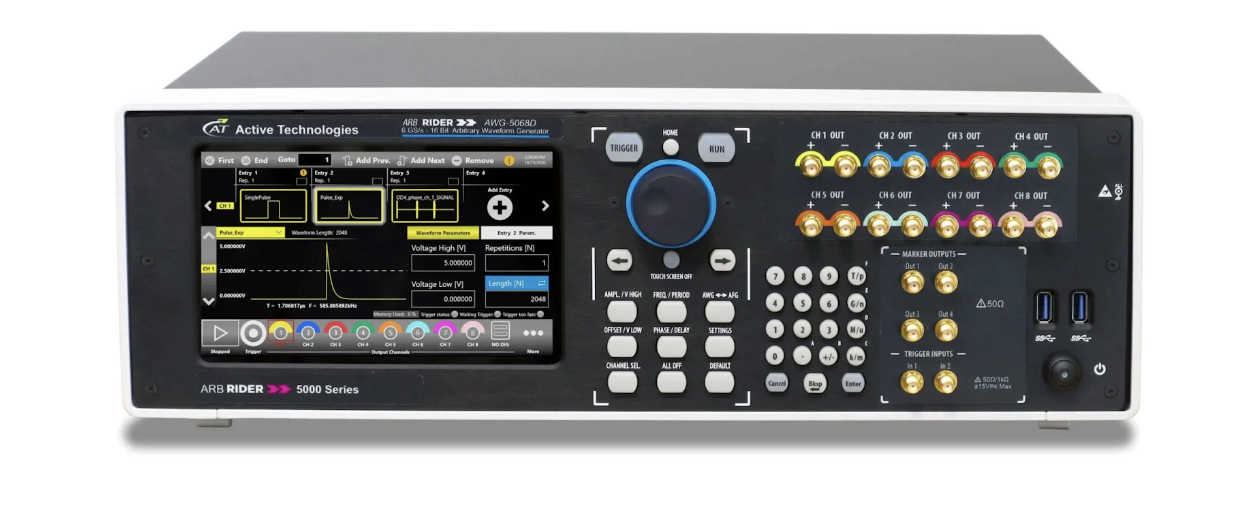
The ARB Rider AWG-5000 from Active technologies is the world’s fastest 16 bit Arbitrary Waveform Generator: 6.16 GS/s real time update rate (12.32 GS/s in RF mode) and 16 bit vertical resolution. Available in 2, 4 or 8 channel models, Arb Rider AWG-5000 is the fastest AFG (Arbitrary Function Generator) in the world, reaching up to 2 GHz sine wave. Thanks to Simple Rider software, AWG-5000 offers best in class performances and extremely easy to use interface.
2 GHz bandwidth, up to 5Vpp output range and up to 4 Gsample memory depth, makes the AWG-5000 is the ideal choice for Physics Experiments, Quantum computers, and Aerospace & Defense applications.
Thanks to the integrated up conversion functionality (RF MODE) it’s possible generate signals up to 6 GHz or when using the RF mode, up to 12.32 GS/s.
Key performance specifications:
- True Arb Mode
- 16-bit vertical resolution
- 6.16 GS/s Variable Clock (12.32 GS/s in RF mode)
- Up to 6 GHz output frequency
- < 110ps Rise/fall time
- 8bit,16bit or 32bit digital channels
- Up to 4 Gpts Waveform Memory per Channel
- Single ended amplitude up to 5 Vp-p into 50 Ω with hardware offset of ±2.5 V into 50 Ω – Differential amplitude up to 3 Vp-p into 100 Ω load with common mode voltage of ±2 V into 50 Ω
- AFG Mode
- 2 GHz Sine Waveforms
- 6.16 GS/s fixed, 16-bit vertical resolution
- Single ended amplitude up to 5 Vp-p into 50 Ω with hardware offset of ±2.5 V into 50 Ω
- Differential amplitude up to 3 Vp-p into 100 Ω load with common mode voltage of ±2 V into 50 Ω
- Improved proprietary DDS based technology
- Pulse Pattern Generator (PPG) Mode
- Optional – Up to 1.5Gbit/s NRZ, RZ and R1 bit stream generation
- 2,3 or 4 levels pattern
- 64 point arbitrary shape per transition
- Programmable duration for any transition – Up to 2Mbit (2 levels) or up to 1Msymbols (3 or 4 levels) pattern memory for channel
- Single ended amplitude up to 5 Vp-p into 50 Ω with hardware offset of ±2.5 V into 50 Ω – Differential amplitude up to 3Vp-p into 100 Ω load with common mode voltage of ±2V into 50 Ω
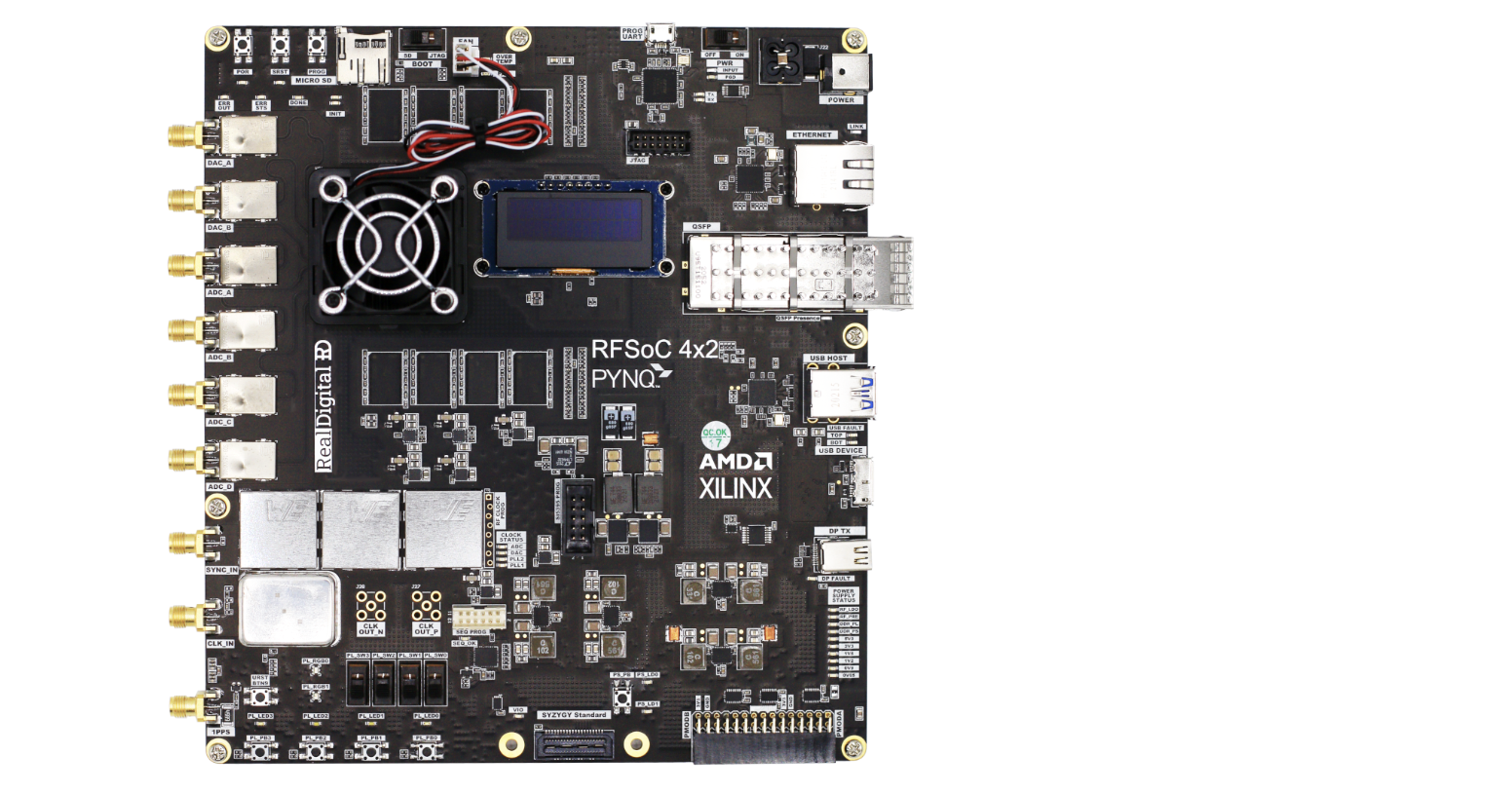
AMD’s Radio Frequency System-on-Chip (RFSoC) devices are a new class of integrated circuits that integrate multiple high-speed ADCs and DACs, a powerful multi-core ARM processing system and a large FPGA into a single monolithic SoC, thereby eliminating the need for external data converters and enabling more accurate cross-channel timing and synchronization. The RFSoC 4×2 board is a complete, ready-to-use system built around AMD’s ZYNQ Ultrascale+ RFSoC ZU48DR device. Featuring four 5 GSPS ADCs with 6 GHz RF input bandwidth and two 14-bit, 9.85 GSPS DACs, the RFSoC board includes:
- QSFP28 port for 4×25, 2×50 or 1×100 Gbps Ethernet & 10/100/1000 Ethernet port
- 8 GBytes of 2400MHz DDR4 (4Gbytes for PS and 4GBytes for PL)
- Ultra-stable, ZCU208 compatible clocking subsystem
- Extensive tutorials and overlays including spectrum analyzer
- Supported by PYNQ open-source framework with Python & Jupyter notebooks
Specifications:
- Xilinx Gen 3 Zynq UltraScale+ RFSoC ZU48DR
- Quad core ARM Cortex-A53, Dual core ARM Cortex–R5F
- Programmable Logic with 930K logic cells, 4272 DSP slices, 38Mb block RAM
- 4x 5GSPS RF ADCs SMA ports
- 2x 9.85GSP RF DACs SMA ports
- External clock and sync ports
- 4 GB 64-bit 2400MHz Processing System memory
- 4 GB 64-bit 2400MHz Programmable Logic memory
- 10/100/1000 Mbps Ethernet
- 100G Ethernet MAC/PCS w/RS-FEC (QSFP28)
- 2 USB3 host ports and USB3 slave port
- USB2 port for JTAG, UART and COM
- Mini DisplayPort
- Multiple high-accuracy and programmable clock sources
- Active power monitoring (current and voltage) for all supplies
- Battery-backed real time clock
- OLED display, 4 LEDs, 2 RGB LEDs
- 4 slide switches, 6 pushbuttons
- Standard SYZYGY port, Pmod+ port (two Pmods)
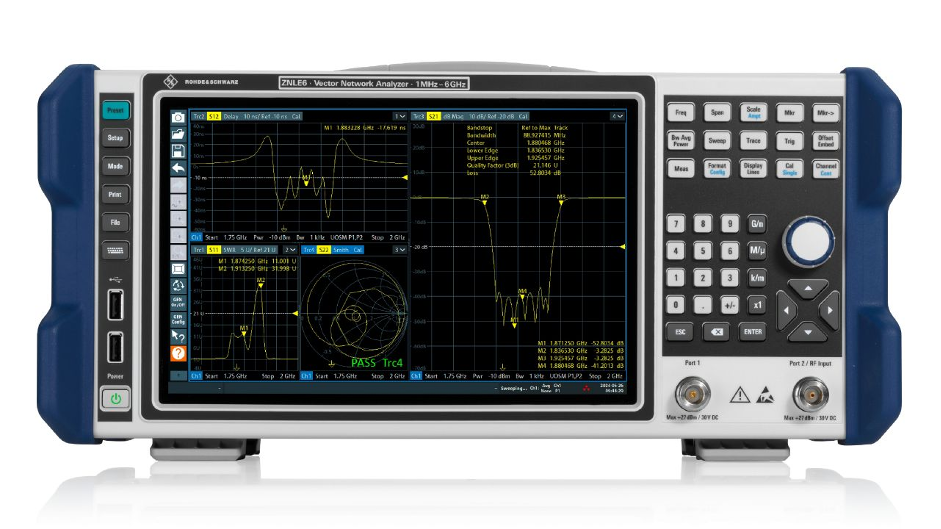
The R&S®ZNLE is a two-port vector network analyzer that can be used for bidirectional measurements of S-parameters S11 , S21 , S12 and S22 on passive components. Configuring the R&S®ZNLE requires only three decisions:
- Choose the frequency range
- Decide whether you need a GPIB interface
- Decide whether you need to perform time domain analysis or distance-to-fault measurements
The analyzer is available with a frequency range from 100 kHz (with R&S®ZNLE-B100 option) up to 20 GHz (R&S®ZNLE18 in overrange). The optional GPIB interface lets you connect a controller to remotely control the R&S®ZNLE. As a standalone instrument, the R&S®ZNLE does not require an external PC to configure the setup. You can start measuring immediately after you switch on the instrument. The time domain analysis option (R&S®ZNL-K2) and distance-to-fault measurements option (R&S®ZNL-K3) enhance the R&S®ZNLE with essential features for general purpose testing.
Device ZNLE6 is equipped with the distance-to-fault measurements option (R&S®ZNL-K3) enhance the R&S®ZNLE with essential features for general purpose testing.