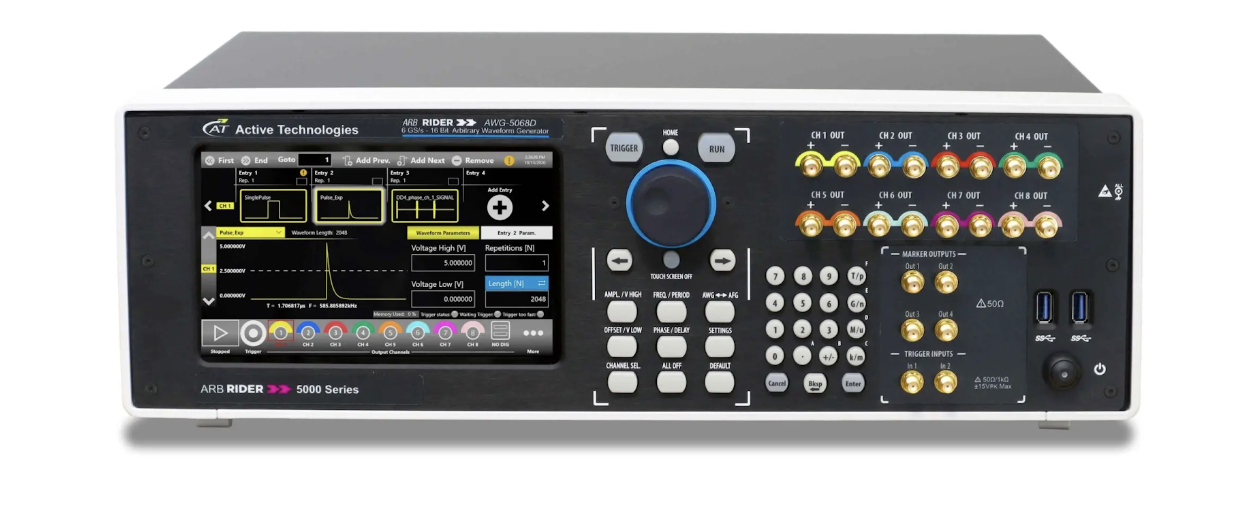
The ARB Rider AWG-5000 from Active technologies is the world’s fastest 16 bit Arbitrary Waveform Generator: 6.16 GS/s real time update rate (12.32 GS/s in RF mode) and 16 bit vertical resolution. Available in 2, 4 or 8 channel models, Arb Rider AWG-5000 is the fastest AFG (Arbitrary Function Generator) in the world, reaching up to 2 GHz sine wave. Thanks to Simple Rider software, AWG-5000 offers best in class performances and extremely easy to use interface.
2 GHz bandwidth, up to 5Vpp output range and up to 4 Gsample memory depth, makes the AWG-5000 is the ideal choice for Physics Experiments, Quantum computers, and Aerospace & Defense applications.
Thanks to the integrated up conversion functionality (RF MODE) it’s possible generate signals up to 6 GHz or when using the RF mode, up to 12.32 GS/s.
Key performance specifications:
- True Arb Mode
- 16-bit vertical resolution
- 6.16 GS/s Variable Clock (12.32 GS/s in RF mode)
- Up to 6 GHz output frequency
- < 110ps Rise/fall time
- 8bit,16bit or 32bit digital channels
- Up to 4 Gpts Waveform Memory per Channel
- Single ended amplitude up to 5 Vp-p into 50 Ω with hardware offset of ±2.5 V into 50 Ω – Differential amplitude up to 3 Vp-p into 100 Ω load with common mode voltage of ±2 V into 50 Ω
- AFG Mode
- 2 GHz Sine Waveforms
- 6.16 GS/s fixed, 16-bit vertical resolution
- Single ended amplitude up to 5 Vp-p into 50 Ω with hardware offset of ±2.5 V into 50 Ω
- Differential amplitude up to 3 Vp-p into 100 Ω load with common mode voltage of ±2 V into 50 Ω
- Improved proprietary DDS based technology
- Pulse Pattern Generator (PPG) Mode
- Optional – Up to 1.5Gbit/s NRZ, RZ and R1 bit stream generation
- 2,3 or 4 levels pattern
- 64 point arbitrary shape per transition
- Programmable duration for any transition – Up to 2Mbit (2 levels) or up to 1Msymbols (3 or 4 levels) pattern memory for channel
- Single ended amplitude up to 5 Vp-p into 50 Ω with hardware offset of ±2.5 V into 50 Ω – Differential amplitude up to 3Vp-p into 100 Ω load with common mode voltage of ±2V into 50 Ω
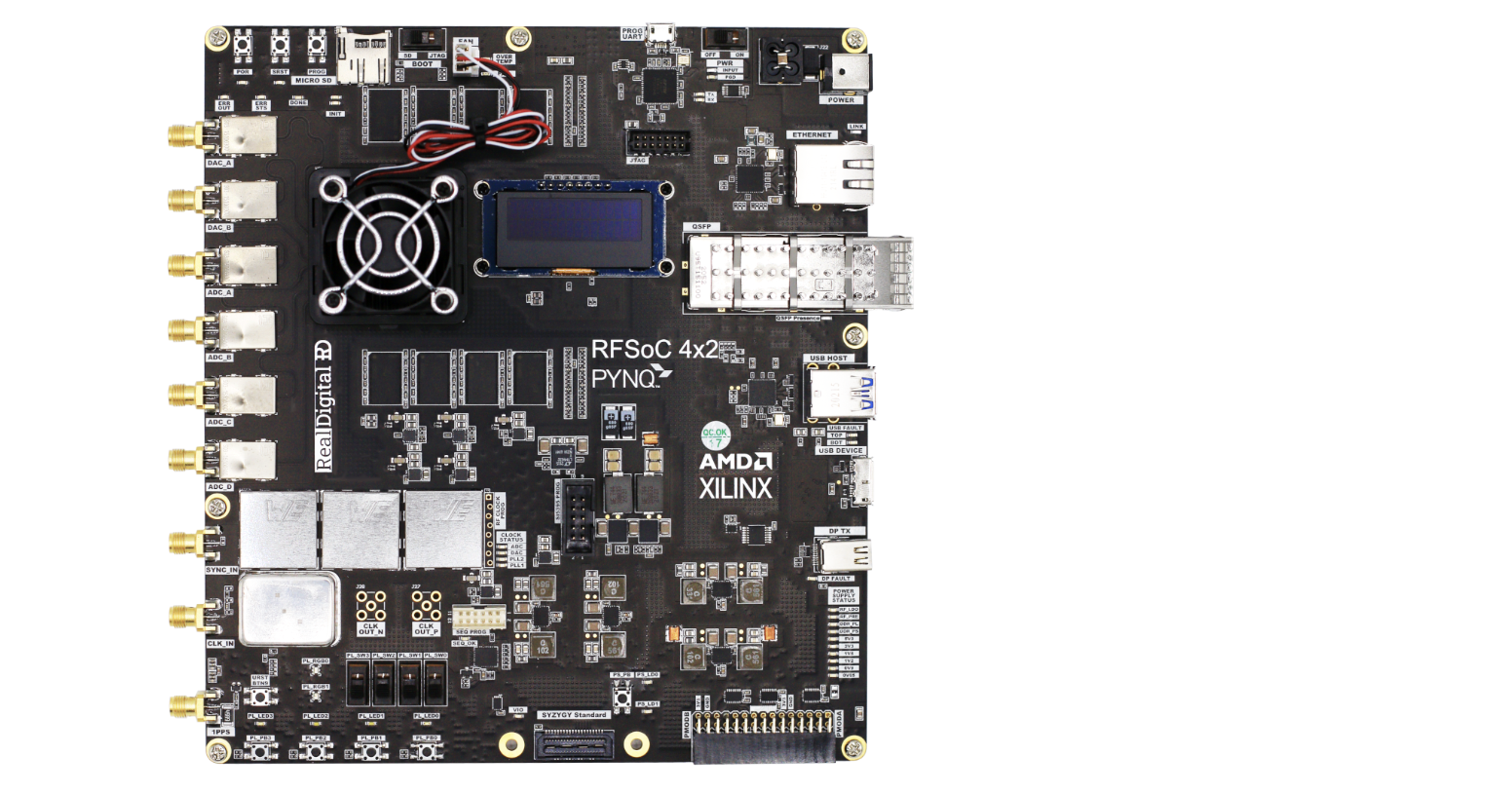
AMD’s Radio Frequency System-on-Chip (RFSoC) devices are a new class of integrated circuits that integrate multiple high-speed ADCs and DACs, a powerful multi-core ARM processing system and a large FPGA into a single monolithic SoC, thereby eliminating the need for external data converters and enabling more accurate cross-channel timing and synchronization. The RFSoC 4×2 board is a complete, ready-to-use system built around AMD’s ZYNQ Ultrascale+ RFSoC ZU48DR device. Featuring four 5 GSPS ADCs with 6 GHz RF input bandwidth and two 14-bit, 9.85 GSPS DACs, the RFSoC board includes:
- QSFP28 port for 4×25, 2×50 or 1×100 Gbps Ethernet & 10/100/1000 Ethernet port
- 8 GBytes of 2400MHz DDR4 (4Gbytes for PS and 4GBytes for PL)
- Ultra-stable, ZCU208 compatible clocking subsystem
- Extensive tutorials and overlays including spectrum analyzer
- Supported by PYNQ open-source framework with Python & Jupyter notebooks
Specifications:
- Xilinx Gen 3 Zynq UltraScale+ RFSoC ZU48DR
- Quad core ARM Cortex-A53, Dual core ARM Cortex–R5F
- Programmable Logic with 930K logic cells, 4272 DSP slices, 38Mb block RAM
- 4x 5GSPS RF ADCs SMA ports
- 2x 9.85GSP RF DACs SMA ports
- External clock and sync ports
- 4 GB 64-bit 2400MHz Processing System memory
- 4 GB 64-bit 2400MHz Programmable Logic memory
- 10/100/1000 Mbps Ethernet
- 100G Ethernet MAC/PCS w/RS-FEC (QSFP28)
- 2 USB3 host ports and USB3 slave port
- USB2 port for JTAG, UART and COM
- Mini DisplayPort
- Multiple high-accuracy and programmable clock sources
- Active power monitoring (current and voltage) for all supplies
- Battery-backed real time clock
- OLED display, 4 LEDs, 2 RGB LEDs
- 4 slide switches, 6 pushbuttons
- Standard SYZYGY port, Pmod+ port (two Pmods)
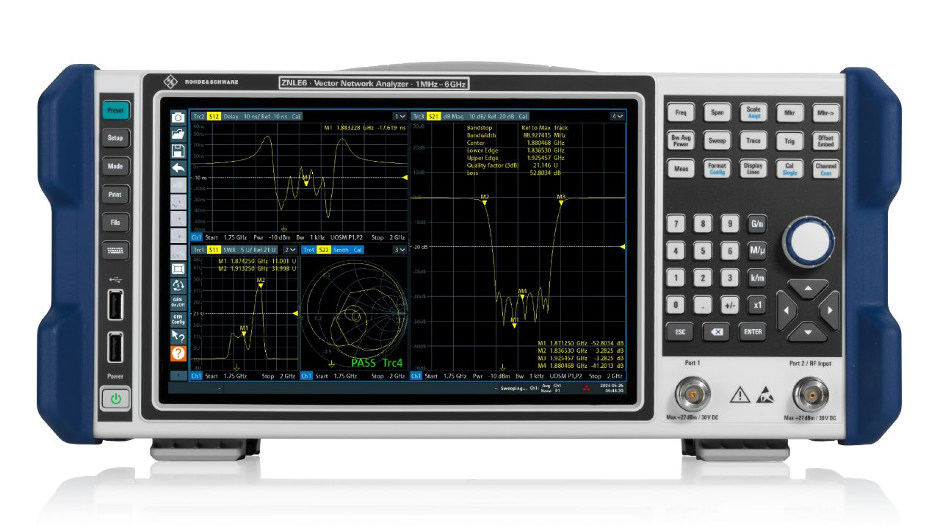
The R&S®ZNLE is a two-port vector network analyzer that can be used for bidirectional measurements of S-parameters S11 , S21 , S12 and S22 on passive components. Configuring the R&S®ZNLE requires only three decisions:
- Choose the frequency range
- Decide whether you need a GPIB interface
- Decide whether you need to perform time domain analysis or distance-to-fault measurements
The analyzer is available with a frequency range from 100 kHz (with R&S®ZNLE-B100 option) up to 20 GHz (R&S®ZNLE18 in overrange). The optional GPIB interface lets you connect a controller to remotely control the R&S®ZNLE. As a standalone instrument, the R&S®ZNLE does not require an external PC to configure the setup. You can start measuring immediately after you switch on the instrument. The time domain analysis option (R&S®ZNL-K2) and distance-to-fault measurements option (R&S®ZNL-K3) enhance the R&S®ZNLE with essential features for general purpose testing.
Device ZNLE6 is equipped with the distance-to-fault measurements option (R&S®ZNL-K3) enhance the R&S®ZNLE with essential features for general purpose testing.
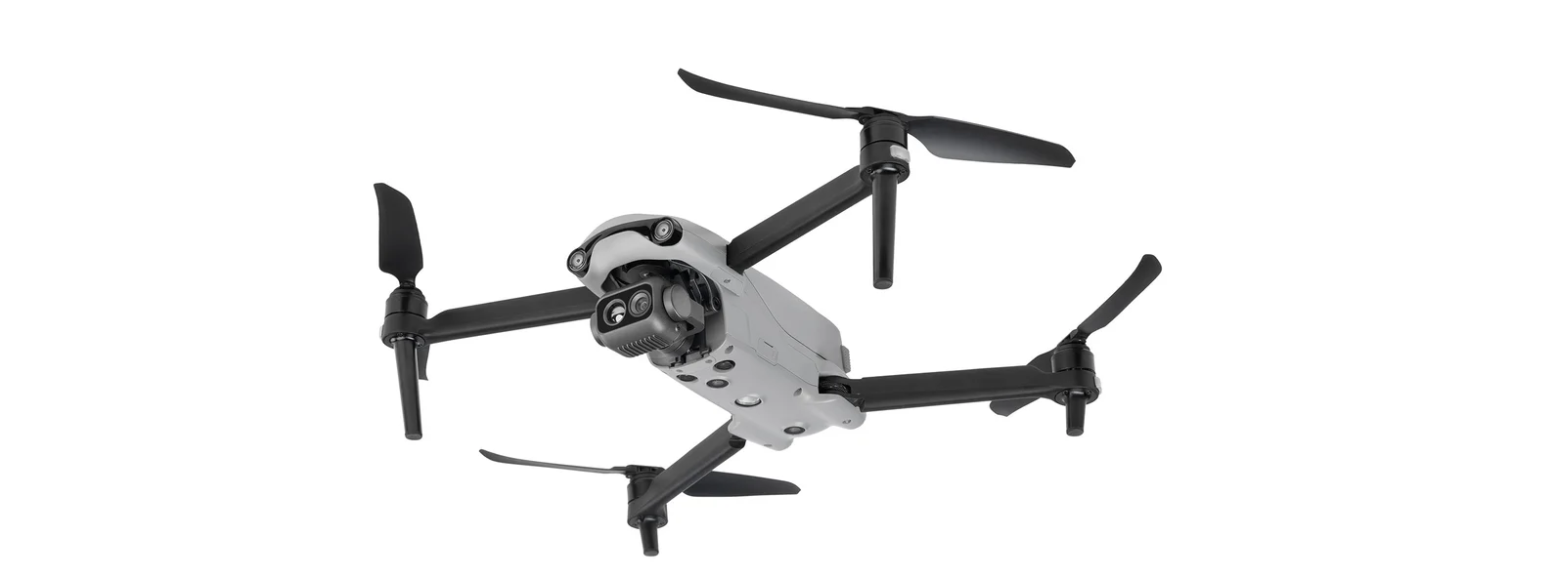
The EVO Lite Enterprise Series, by Autel Robotics, offers multiple advantages such as a lightweight and portable design, rapid deployment, and simple control for industrial applications. The AI target recognition feature enables the aircraft to easily identify and map various target objects automatically. The three-way binocular vision obstacle avoidance provides a safe flying experience.
The EVO Lite 640T Enterprise features a dual gimbal system, with a visible-light camera providing clear and detailed images, while the thermal-imaging camera aids in decision-making during operations. Paired with the Autel Enterprise professional flight software, it offers easy operation, user-friendly interaction, flexible single-person deployment, and efficient application in scenarios such as public safety and emergency rescue.
Main Features
- Lightweight and Portable
- 640*512 Infrared Thermal Imaging
- 6K Resolution
- 12km Video Transmission Range
- 40-Minute Flight Endurance
- Three-Way Binocular Vision Obstacle Avoidance
- AI Target Recognition and Positioning
- Simple Control With Smart Controller SE V2
The DJI Mavic 3T is a thermal imaging drone equipped with a powerful flight control system that enables precise control and maneuverability. It has a top speed of up to 72 km/h and a maximum flight time of up to 31 minutes. The drone also features an obstacle avoidance system that helps it avoid obstacles during flight.
The Mavic 3T is equipped with a powerful 4K camera capable of capturing stunning aerial footage. It has a 1/2.3-inch CMOS sensor and a 24mm equivalent lens with an f/2.8 aperture. The camera also features a 3-axis gimbal that helps stabilize footage and reduce camera shake.
The DJI Mavic 3T also offers a range of intelligent flight modes that make it easier to capture the perfect shot. These include ActiveTrack, Point of Interest, Waypoint, and Follow Me. These modes allow the drone to autonomously follow a subject or fly along a predefined path.
The Mavic 3T also features a number of safety features that make it a safe and reliable drone to fly. These include an emergency stop button, low battery protection, and an automatic return-to-home function.
Main Features
- Wide-angle camera: 24 mm equivalent focal length, 48 MP with zoom: 162 mm equivalent focal length, 12 MP, 56× hybrid zoom
- Thermal camera: 61° field of view, 40 mm equivalent focal length, 640 × 512 resolution
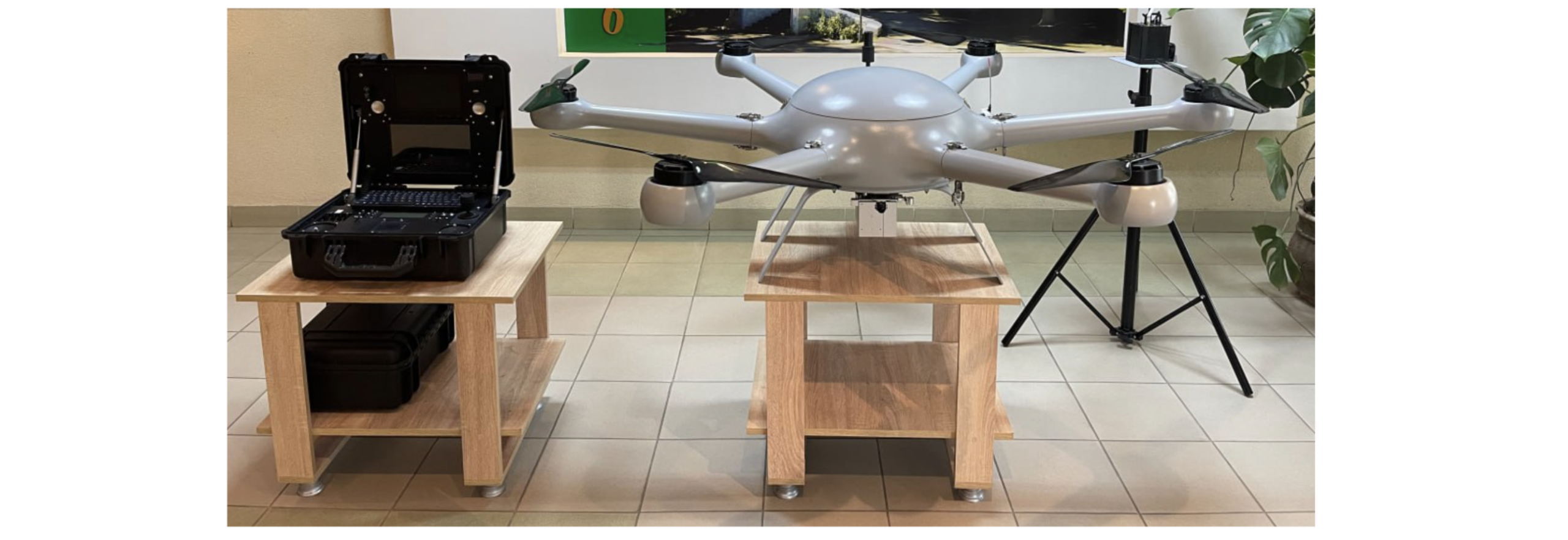
Description Unmanned Aircraft system with integrated LiDAR
Aircraft Type: Multirotor
Propulsion Type: Electric / Hybrid
Energy Storage: LiPo / Solid-state Li-ion cells, Gasoline (as applicable)
Frame Type: Enclosed (fuselage), foldable
Propeller Diameter: ≤ 30 inches
Operational Weight: 25–28 kg
Maximum Takeoff Weight (MTOW): 50 kg
Flight Time (with payload): 40–50 minutes
Flight Modes: Manual / Assisted / Automatic / Autonomous
Control Station: Advanced, based on Windows 10 / Windows 11 OS, including control, telemetry, and onboard video
Control Range: 50 km line-of-sight
Environmental Resistance: Moderate precipitation, wind < 12 m/s
Certificate of Origin: Provided
Warranty: Minimum 2 years from manufacturer
LiDAR Technology
Measurement Range: 180+ m, 70° FOV
Laser Class: 905 nm, Class 1
Accuracy: < 2 cm at 20 m
Optical Sensor: 24 MP, 70° FOV
GNSS:
GPS L1 / L2 / L5
GLONASS L1 / L2
BeiDou (BDS) B1 / B2 / B3
Galileo E1 / E5a / E5b
Data Storage: Onboard
Operating Temperature Range: −20°C to +55°C
Manufacturer: Republic of Moldova
Model: Unmanned Aircraft system with integrated LiDAR
Serial number: DAUSM01
Date of purchase: 2025
Cost: 50000€
Location (Country/Institute/Room): Moldova State University, Office “Education for Drone”, Room 429, Building 4, 60 Alexei Mateevici Street, Chișinău, Republic of Moldova